
Introduction:
Coco Coir has emerged as one of the most powerful natural growing mediums for today’s farming systems, and its rapid global demand is strongly supported by every leading coir products manufacturer, coir products exporter in India, and large-scale substrate supplier. As modern agriculture shifts toward sustainable, soil-friendly, and high-yield cultivation methods, Coco Coir has become the preferred choice for growers, hydroponic farms, nurseries, and global importers.
From moisture retention to soil rehabilitation, the coco coir benefits are far wider than what farmers traditionally expected. With India being a leading coir products manufacturer in India and exporter to Europe, the Middle East, Africa, and Southeast Asia, Coco Coir is shaping the next generation of modern agriculture in a powerful way.
Coco Coir Enhances Soil Structure Naturally
One of the most surprising coco coir benefits is its ability to improve soil structure without altering the natural ecosystem. When mixed with soil, Coco Coir creates channels for air, roots, microbes, and nutrients. This prevents hardening, cracking, or compacting, which commonly happens in traditional farming soils.
Manufacturers highlight this feature as a major advantage for crops grown in challenging climates.
Consistent Moisture Retention for Healthier Plants
Coco Coir can hold water up to 10 times its weight, making it a perfect substrate for:
- Greenhouses
- Vertical farms
- Nursery propagation
- Seed starting
- Commercial vegetable farming
Even in dry climates, Coco Coir ensures stable root-zone moisture, helping growers reduce irrigation frequency and operational costs. This is one of the top reasons global importers source from a coir products manufacturer in India, known for quality and consistency.
Coco Coir Supports Stronger Root Development
Roots grow deeper, stronger, and healthier in Coco Coir because of its naturally porous structure. Unlike dense soils, Coco Coir does not suffocate the roots.
With better root aeration:
- Nutrient uptake increases
- Plants grow faster
- Disease resistance improves
This benefit is especially valued by hydroponic producers who regularly collaborate with a coir products exporter in India for bulk supplies.
Looking for premium export-grade Coco Coir? Contact a trusted coir products manufacturer and exporter for bulk orders.Contact us for bulk orders and export pricing at Coir Genie and email us at contact@coirgenie.com
Sustainable & Eco-Friendly Alternative to Soil-Based Media
Coco Coir is created from coconut husks — a renewable byproduct. It requires no mining, no chemical processing, and causes zero damage to the environment, making it a far more responsible alternative to peat moss or synthetic media.
India, being a leading coir products manufacturer and exporter, plays a major role in global sustainability by supplying millions of tons of eco-friendly coir products every year.
Coco Coir Performs Exceptionally in Hydroponics
Hydroponic and soilless cultivation depend on stable media that maintain moisture balance and support nutrient absorption. Coco Coir excels in this because:
- It drains excess water
- Retains essential moisture
- Prevents nutrient lockouts
- Maintains steady EC levels
This makes it the top-growing substrate supplied by Indian exporters to countries such as Japan, South Korea, the UAE, the Netherlands, and Germany.
pH Balanced for Optimal Nutrient Absorption
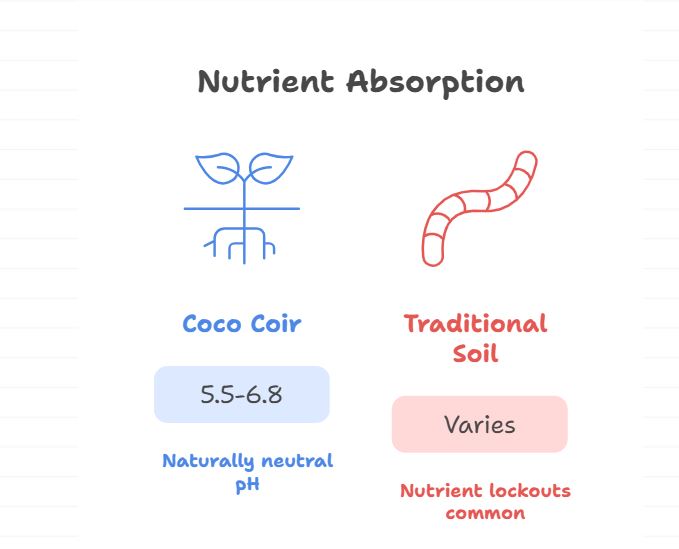
Another underrated Coco Coir benefit is its naturally neutral pH level (5.5–6.8).
This minimizes the common issue of nutrient lockouts seen in traditional soil-based farming. Farmers using coir consistently report:
- Stronger nutrient absorption
- Healthier leaves
- Higher fruiting rates
This performance advantage contributes to India’s dominating presence as a coir products exporter in India.
Cost-Effective & High-Value for Importers
Coco Coir is far more cost-efficient than synthetic media or imported peat-based substrates.
Buyers prefer Indian suppliers because:
- Production quality is high
- Raw materials are abundant
- Export processes are streamlined
- Global shipping routes are strong
- Prices are competitive
This value-driven advantage makes India the top global hub for Coco Coir products.
How Coco Coir Compares With Traditional Growing Media
Compared to peat moss, garden soil, and synthetic grow media, Coco Coir clearly stands out:
- More sustainable
- Higher moisture retention
- Better aeration
- No chemical residues
- Biodegradable
- Enhances long-term soil fertility
Importers increasingly choose Coco Coir over alternatives because it delivers consistent growth results.
Conclusion:
Coco Coir has evolved from a simple coconut byproduct to a revolutionary agricultural substrate that offers unmatched sustainability, performance, and economic value. The coco coir benefits — from moisture regulation to root support — make it the preferred choice for modern growers worldwide. With India leading the global market as a trusted coir products manufacturer and coir products exporter in India, Coco Coir continues to reshape agriculture across continents.
👉 Ready to source premium Coco Coir for bulk export? Contact us for bulk orders and export pricing at Coir Genie and email us at contact@coirgenie.com
Frequently Asked Questions (FAQs)
1. What is Coco Coir and why is it used in agriculture?
Coco Coir is a growing medium made from processed coconut husks. It is widely used due to its water retention ability, sustainability, and excellent root aeration.
2. How long does Coco Coir last in farming applications?
Coco Coir typically lasts 3–5 years depending on climate and usage. It breaks down slowly and enriches the soil over time.
3. Why is India a top supplier of Coco Coir products?
India is the largest coconut producer with advanced processing units, making it a leading coir products manufacturer in India and global exporter.
4. Is Coco Coir safe for hydroponic systems?
Yes. Coco Coir is one of the best substrates for hydroponics due to its balanced pH, moisture retention, and ability to prevent root diseases.
5. Can Coco Coir be reused?
Yes, Coco Coir can be reused after proper cleaning and buffering, making it cost-effective for commercial farms.